Beyond keyword alerts: how LeadsRun began
Keyword alerts for Reddit and X found my customers, then buried them in noise. How that led to LeadsRun, an AI agent that listens to your market for you.
 Paweł Z.Founder

A while ago I was building a different project, Deal Simulator, an app for practising sales calls. Nothing about LeadsRun was on my mind yet. Then I asked a small question on X, and the answer I got stayed with me for weeks.
I needed analytics for Deal Simulator's landing page, so I asked on X if anyone could recommend a website analytics tool. The next day, a product manager at Mixpanel replied. The reply called itself a shameless plug, but it was helpful, and I said I'd give Mixpanel a try.
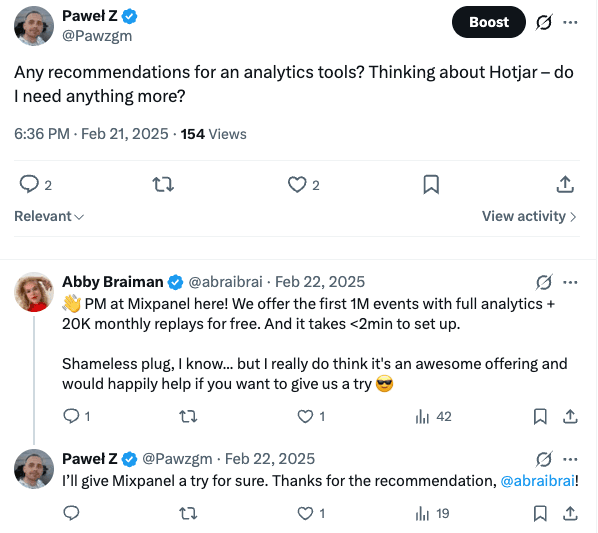
But the tool wasn't what stayed with me. I had a small account. The post has 154 views to this day, and nobody was following me for analytics advice. So how did someone at Mixpanel find it?
How did they find my post?
They were almost certainly listening for keywords. There is a whole category of tools that watch X, Reddit and other sites, and send you an alert the moment someone writes a word you care about: your product's name, your category, a problem you solve. Someone asks for "website analytics", a tool spots it, a person replies.
I went looking and found plenty of them, from free ones like F5Bot, which emails you when a keyword appears on Reddit and a few other sites, to paid social listening platforms.
For a founder with no audience, the idea felt huge. The people who need what you're building are already describing their problem, in public, every day. You just have to hear them. So I set up keyword alerts for Deal Simulator.
Why do keyword alerts get so noisy?
Because a keyword matches words, not meaning. "Sales practice" turns up in posts from people who want to practise sales calls. It also turns up in job ads, in people selling their own courses, and in threads about practice schedules for a football team.
The obvious fix is better keywords, and that is where I got stuck. I wanted to reach as much of my market as I could, so I kept adding more: "cold call nerves", "objection handling", "sales role-play", "sales training". Every new keyword caught a few more of the right posts and a lot more of the wrong ones.
You end up trading reach for noise:
- Narrow keywords keep your inbox clean, but you miss everyone who describes the problem in their own words.
- Broad keywords catch those people, and bury them under posts you have to read and throw away.
Either way, you become the filter. Reading alerts turns into a daily chore, and the posts that matter still slip through. Coming up with the keywords was the hardest part of the whole setup for me, and the better I got at it, the more there was to read.
When I later measured it for Deal Simulator, the numbers matched the feeling:
What if AI did the reading?
The fix I wanted was simple: keep listening, but let AI read every post the way I did. Instead of asking "does this post contain my keyword?", ask "is this person describing a problem my product solves?"
That was the first version of LeadsRun: keyword alerts with an AI filter on top. It worked. The noise dropped, and what was left was worth reading.
Then I noticed something. Once the AI understands the product, the keywords stop doing much of the work. It can tell who the product is for, what problem it solves and how those people talk about it. And if it can do that, you don't need to come up with keywords at all, which was the part I struggled with most.
How does LeadsRun find the right posts without keywords?
LeadsRun's agent goes through posts on Reddit, X and the other places where founders' customers talk, and turns each one into an embedding: a numerical fingerprint of what the post means, not which words it uses. Two posts about freezing on a sales call end up close together, even if one says "I choke on objections" and the other "my mind goes blank when they push back".
When you add your product, the agent learns what it does and who it's for. It searches by meaning for posts about that problem, in whatever words people use, and finds everything that belongs to your field. Then it reads the closest matches one by one, against your product, and decides what each one is.
The scale is what makes the difference. In a test for Deal Simulator, it searched 582,354 posts to find 1,600 worth reading closely, spread across 1,149 different communities. I couldn't have read that many by hand, and I wouldn't have thought of the keywords for most of them.
Why did it become more than a lead finder?
Because once the agent understands the posts, a lead is only one of the things in them. The same posts that hold a buyer also tell you:
- Pain points: what hurts, in the customer's own words.
- Vocabulary: the phrases people use, which belong on your landing page.
- Workarounds: how people cope today, and what you are really up against.
- Insights: patterns across many posts that no single post shows.
So LeadsRun grew from a smarter alert into a way to understand a market. For Deal Simulator, the most useful finding wasn't a lead at all. It was that sales reps usually know what to say, but freeze when the call is live. That changes how you'd describe the product, and what you'd build next.
It also made the start much simpler. With keyword tools, onboarding meant a blank box and a long think about which words to track. Now you paste your website, and the agent does that thinking.
What do you get on day one?
You paste your product's website. The agent works out what it does and who it's for, and builds your first market report right away, from what people have already posted: who is asking for something like it, what hurts, how they put it, how they cope today, and what it all adds up to. There is nothing to set up and nothing to wait for.
After that, it keeps listening, and new posts that matter come in as people write them.
Who is it for?
Founders who would rather be building than reading alerts. Especially early on, when the most useful thing you can learn is whether anyone wants what you're making, and how they describe the problem when you're not in the room.
Where it goes from here
That one reply on X taught me that the market is talking all the time. Keyword alerts were my first way to hear it, and they taught me mostly how much noise there is. LeadsRun is my attempt at the tool I wished I'd had then.
I made it for myself, but I think it can help a lot of founders check their ideas before they build, and run their products better. If you try it, I'd love to hear what it finds for you.
Every day, the posts
that matter to your product.
Nothing else.

Keep reading

 Lead generationJun 9, 2026
How to get your first customers on X (Twitter) without paid ads
You don't need followers or an ad budget to get customers on X. Five tactics that work from zero: cold DMs people answer, useful comments, and posts that build trust.
 Lead generationJun 5, 2026
How to find leads on social media without being spammy
Cold DMs and cold prospecting barely work. Here's a smarter way to find leads on social media: the people already asking for what you sell on Reddit, Hacker News and X.